Search the best Facebook ads agencies and you get a wall of shops promising the same thing: profitable, scalable Meta growth. Almost every one can show you a strong ROAS number. The problem is the number is usually inflated. Meta counts conversions that would have happened anyway, and a single-channel Facebook agency quietly claims credit for every sale its ads so much as touched, including demand your email, your Google, or your organic search actually drove. So the reported ROAS looks great while your real new-customer growth flatlines. Telling incremental lift apart from that borrowed credit takes real cross-channel reporting, which is why we built M-K-O-S (mkos.ai), proprietary tooling that pulls Meta, Google, and Shopify into one honest view and turns human strategy into AI-run execution. Then there's the ceiling nobody mentions: creative. Most agencies cap how much they can produce, so your spend stalls the moment your ads fatigue. Templated creative, three weeks to fatigue, climbing CPMs, slipping ROAS. That bottleneck is exactly what we remove with unlimited performance creative. This guide cuts through both problems: first the five questions that actually predict ROAS on Meta, then a shortlist of the best Facebook ads agencies for DTC brands, scored against them.
Full disclosure: we run one of the agencies on this list. We've put our own shop at #1, and under every pick, ours included, you'll find who it's a bad fit for. The five questions come first, so you can grade any agency yourself, us included.
How We Ranked the Best Facebook Ads Agencies
Most "best agency" lists rank names and give you no way to check the ranking. These five questions do the opposite. Each one exposes a specific way agencies cut corners on Meta. Ask them of every shop you're considering, ours included.
The 5 Questions That Separate a Great Meta Agency From an Expensive One
- How many net-new creative concepts do they ship a month, and what does each cost? Meta's Andromeda system groups near-identical ads by Entity ID, so ten spins of one idea won't save a fatiguing account. You need genuine variety across formats, angles, personas, and talent. Most agencies cap you at a handful, because human production (shoots, editors, turnaround time) is their bottleneck. That cap quietly becomes your growth ceiling. It's the exact ceiling we engineered around: our performance creative runs on AI-driven volume at near-zero marginal cost per concept, so creative never caps the spend.
- Do they optimize to incremental attribution, or report platform-standard ROAS? Meta ships a separate attribution-model setting that most agencies leave on Standard. Standard credits the last click before a sale that may have been coming anyway. Incremental optimizes for the purchases the ad actually caused. Ask whether they report new-customer ROAS, the one number you can't inflate by re-converting buyers you already had. If in-platform ROAS on standard attribution is all they can show you, they're reporting what flatters them, not what grows you.
- Exactly how do they scale spend without collapsing ROAS? There's a real method behind it: an ABO → CBO → cost-cap progression, with bid-cap discipline to hold a ROAS floor while pushing budget, proven on broad ASC structures past $15K/day. If there's no structure behind the answer, just "we raise budgets and watch it," they're hoping, not scaling.
- Can they show real managed spend and ROAS at your level, not one vanity screenshot? A three-year-old screenshot from a $5K account is not proof. Ask for recent numbers at the scale you're trying to reach. For reference, the kind of number to ask for: $250K+/month held at ~4x ROAS, or an account taken from 2x to 7x while spend scaled from $3K to $40K/month. If a shop can't put comparable, current figures on the table, treat the case study as marketing, not evidence.
- Who actually touches your account after the pitch? The senior who closes you is rarely the one who runs you. Ask who makes the daily calls on your spend, and ask to meet them before you sign. Then ask the number that predicts focus: how many accounts does one buyer carry? Seniority matters, but mindshare is math. Even with AI tooling carrying the load, two to four accounts per operator is healthy, five at the absolute max. A buyer carrying five to fifteen brands isn't an expertise problem, it's a split-attention one. Do the math on how much of a week is left for yours after fifteen sets of calls, reports, and mid-day Slack fires. And watch for the shop that white-labels the actual media buying to a cheaper vendor behind the logo, where you'd be paying agency rates for a team you never chose.
The 7 Best Facebook Ads Agencies in 2026
Here are the seven best Facebook ads agencies worth a real conversation, graded against the five questions above. We've put our own shop first and told you plainly who each one is wrong for. This list is DTC-eCommerce-first: brands that make and sell their own product line, roughly $2M–$50M a year, AOV around $75–$200. If that's not you, the "best for" column points somewhere better. It's also the difference between this and the average "best facebook ad agencies" list, which ranks names with no reasoning attached.
One note on the grades: they score fit for a DTC eCommerce brand scaling on Meta specifically, not overall quality. A strong SMB-social or full-service shop grades lower here only because that isn't a dedicated DTC-Meta specialist, not because the work is weak.
How the grade is built. Each agency is graded on how well its public positioning fits a DTC eCommerce brand against the five questions — not on private data we can't see. An agency that clearly lives in DTC eCommerce Meta and covers most of the five lands in the A range; one that's capable but splits focus across channels or verticals sits in the B range; one built for a different sport entirely (SMB social, search-led, enterprise, B2B) grades in the C range for this use case, no matter how good the work is.
| Grade | What it means for a DTC eCommerce brand on Meta |
|---|---|
| A+ / A- | Specialist fit — strong on most or all five questions, lives in DTC Meta |
| B+ / B / B- | Capable — strong on several, but splits focus across channels or verticals |
| C+ / C | Mismatch for DTC Meta — excels in a different lane (SMB social, search-led, enterprise, B2B) |
| # | DTC-Meta Fit | Agency | Best for | A bad fit if… |
|---|---|---|---|---|
| 1 | A+ | Paul Klebanov | DTC brands scaling Meta with AI creative | you want the cheapest seat, not a senior operator |
| 2 | A- | Common Thread Collective | profit-first DTC scaling on Meta + Google | you want one hands-on senior buyer, not a large system-and-team engine |
| 3 | B+ | Adspace Agency | a full-service shop that's strong on Meta | you want a specialist who only lives in the Meta auction |
| 4 | B+ | inBeat Agency | UGC + influencer-driven paid social | you want a full-funnel media buyer, not creator-led creative |
| 5 | B+ | Darkroom | DTC brand-building + performance in one shop | you need deep, current Meta performance numbers up front |
| 6 | B | MuteSix | creative-led DTC paid social at scale | you want a lean Meta-only setup, not an omnichannel bench |
| 7 | B- | LYFE Marketing | small-business social media management | you're a $2M+ DTC brand scaling Meta hard |
1. Paul Klebanov — Best for DTC Brands Scaling Meta With AI Creative
Overview. We're a boutique Facebook and Instagram ads agency for DTC eCommerce brands — owner-led, with a small senior team. 15+ years, $200M+ in lifetime managed ad spend, accounts from $25K to $1M+ a month. A senior operator runs your account day to day and makes the calls on your spend, so you get experienced judgment, not a junior learning on your budget.
Why we stay small on purpose. We take on a limited number of brands at a time and turn down the ones we don't believe we can move the needle for, because senior attention doesn't scale to hundreds of accounts and we won't pretend it does. The founder builds our proprietary tooling, M-K-O-S, while running client accounts, so the person shaping your Meta strategy is the one who built the system executing it.
The proof, current and specific. Our best single result: an extra +$100K/mo at 3x ROAS, run entirely on AI-generated ads. The brand was stuck at six figures because creative production couldn't keep up, and removing that bottleneck let it scale at near-zero marginal cost per concept. On Meta we've held ~4x ROAS at $250K+/month and taken an account from 2x to 7x while scaling spend from $3K to $40K/month. For fashion and jewelry brands, 2.5x–4x at scale.
How we fit the five questions. Every package includes unlimited performance creative, powered by M-K-O-S and scoped to your budget and testing plan, so creative volume is never the ceiling it is at production-bound shops. We run to Meta's incremental attribution model and hold to new-customer ROAS, not platform-standard numbers. We scale with ABO → CBO → cost-cap discipline and stay current on Andromeda, GEM, and Lattice at a technical level. We only do eCommerce, with no lead-gen split. And we run Meta and Google as one funnel; if you also need email, we work alongside a Klaviyo email agency rather than pretending to own every channel.
Notable clients. Googan Squad, MaxiClimber, Gorjana Jewelry, HatClub, Finks Jewelers, R. Riveter, and Alani Nu prior to its acquisition.
Best fit for. DTC eCommerce brands doing $2M+ a year that want a senior operator and unlimited performance creative — not the cheapest seat.
The honest caveat. This isn't the cheap option. Our retainer starts at $6K+/month and we require $20K+/month in ad spend, priced on the tooling and senior time, not hours. If you're under ~$2M in revenue or want the lowest invoice, we're the wrong call, and one of the picks below will serve you better.
Ready to talk? Schedule a call.
2. Common Thread Collective — Best for Profit-First DTC Scaling
Common Thread Collective is a DTC eCommerce agency built around profit, not just revenue: growth forecasting, Meta and Google buying, creative, incrementality measurement, and their own analytics tool, Statlas. Like the best DTC shops, they build their own software and actually measure incrementality, which most agencies skip. That makes them a genuine DTC-Meta specialist and a strong fit for a brand that wants profit-first forecasting from one growth partner.
Honest fit note. Their strength is enterprise-grade software paired with a dedicated team. The trade-off is scale: inside a large system-and-team engine, no single senior operator hands-on owns your Meta account the way a boutique shop does. If you want one experienced buyer personally running your spend day to day, weigh whether that structure fits how you work.
3. Adspace Agency — Best for a Full-Service Shop That's Strong on Meta
Adspace is a full-service digital agency, covering strategy, design, and digital marketing under one roof, with Facebook and Instagram ads among its stronger offerings. For a brand that wants Meta handled alongside web, creative, and broader marketing by a single team, that one-stop structure is the draw.
Honest fit note. Full-service breadth means Meta is one service among several, not the whole shop. If you want a specialist who lives in the Meta auction all day and optimizes purely for DTC economics like CAC, AOV, and creative volume, confirm how much of your engagement is dedicated paid-social media buying versus general marketing.
4. inBeat Agency — Best for UGC + Influencer-Driven Paid Social
inBeat is built around creator-led creative: UGC and influencer content feeding paid social. Since creative volume is the real ceiling on Meta scale, a shop that produces a steady stream of native-feeling UGC has a genuine edge on the axis most agencies are weakest.
Honest fit note. Their center of gravity is creative and creator sourcing more than full-funnel media buying and incrementality measurement. If you want one team owning the scaling structure and the ROAS math, not just the content pipeline, ask how deep their in-account media buying goes.
5. Darkroom — Best for Brand + Performance Under One Roof
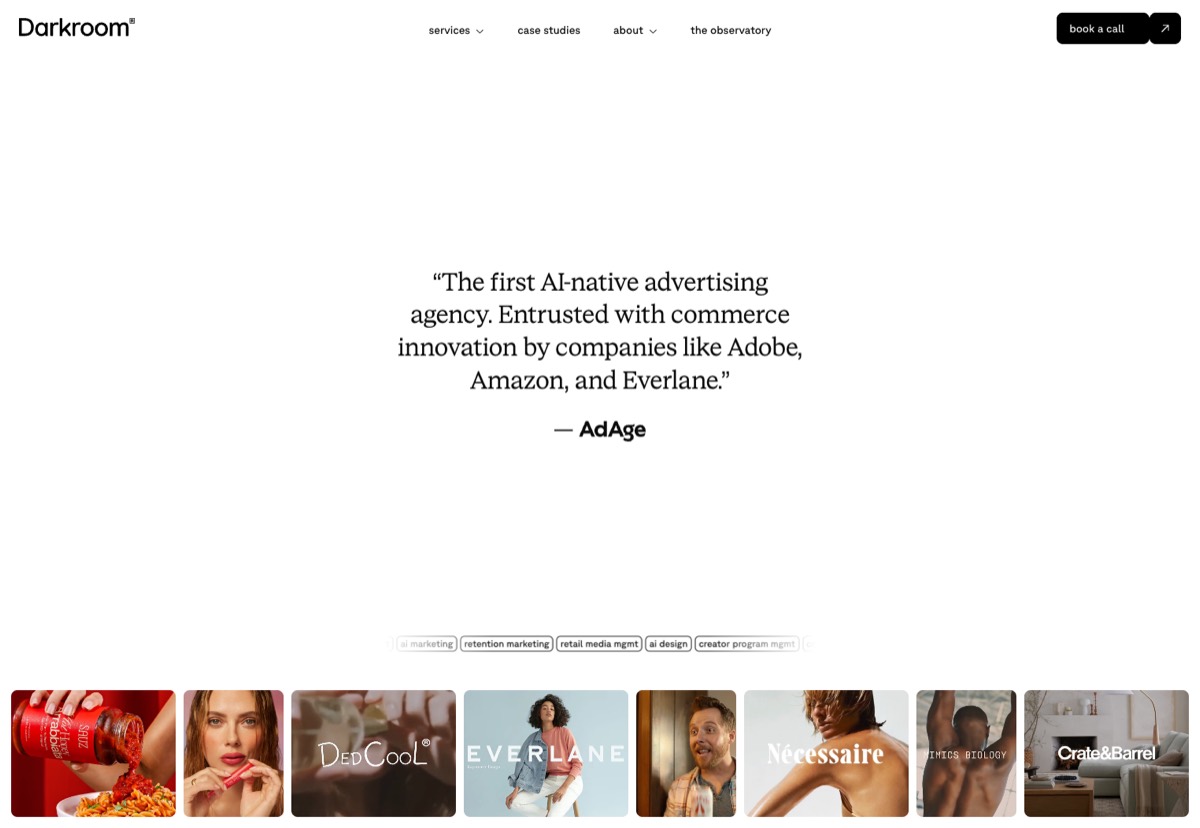
Darkroom is a DTC-focused agency that pairs brand-building with performance media, so creative direction and paid acquisition come from the same shop. On Meta, that means the people making your ads and the people buying your placements sit on one team. It's a strong fit if brand and performance keep pulling in different directions and you want one group owning both.
Honest fit note. If your first requirement is deep, current Meta performance data before you sign, ask hard for it. Their strength is the brand-plus-performance combination; make sure the paid-side proof matches the creative polish.
6. MuteSix — Best for Creative-Led DTC Paid Social at Scale
MuteSix began as a Facebook-ads agency and still leads with a heavy creative bench: paid social, paid search, and in-house creative production at scale. Their case studies skew DTC eCommerce, and creative-led paid social is the calling card. For a DTC brand whose growth depends on creative volume, that production muscle is a real strength.
Honest fit note. MuteSix now sits inside a larger holding-company structure, and the offering runs broad and omnichannel. If you want a lean, Meta-focused setup run by a boutique senior team, not surface area across many channels, weigh that scale before signing.
7. LYFE Marketing — Best for Small-Business Social Media Management
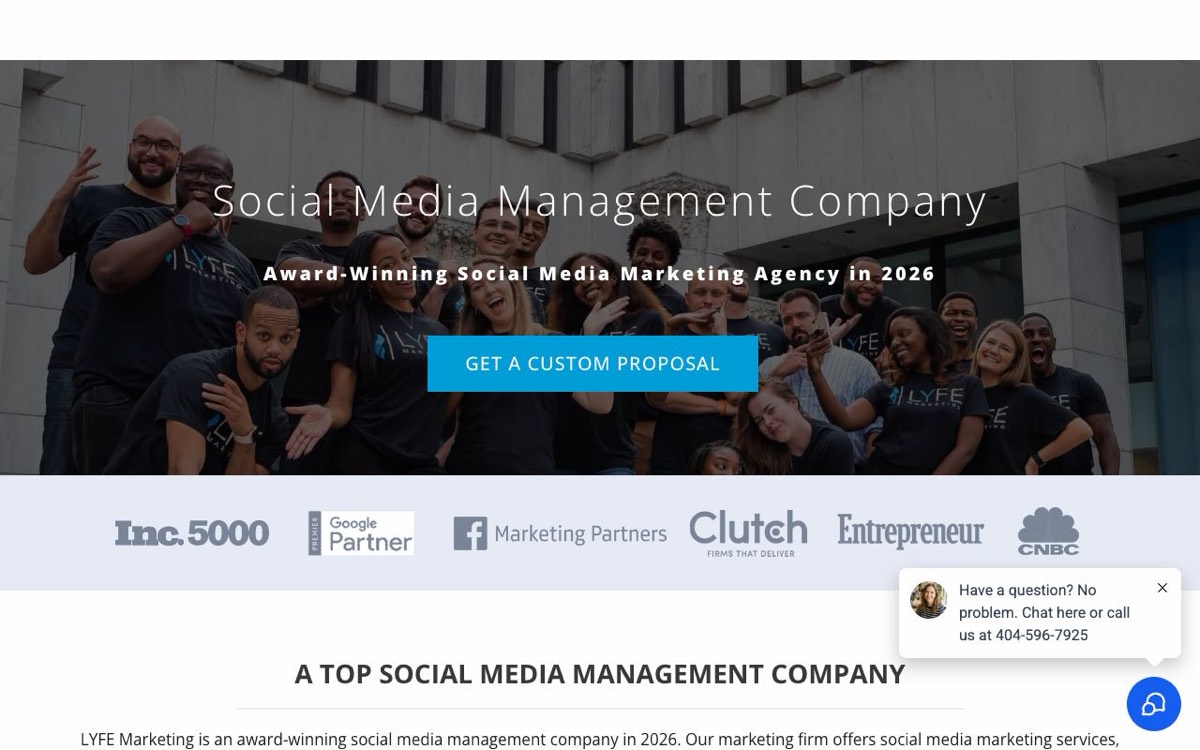
LYFE Marketing bundles social media management with Facebook and Instagram ads for small businesses, handling a full social presence in one place at accessible budgets. For an SMB that wants organic posting and paid social under one roof, that packaging makes sense.
Honest fit note. The model is built for small-business social management, not $2M+ DTC brands scaling Meta hard. If your growth lever is creative volume and incrementality-driven spend at scale, a broad SMB social shop is playing a different game than a DTC-Meta specialist.
A few names you'll see on other "best Facebook ads agency" lists — TechnologyAdvice, AgencyVista, Clutch — are review directories, not agencies. They're useful for reading more reviews, but you're hiring an operator, not a directory.
Want a senior operator to run these numbers on your own account? Book a Meta ads strategy call.
What the Top-Ranked "Best Meta Ads Agency" Lists Miss
Search "best Facebook ads agency" or "best meta ads agency" and the top results split three ways: an anonymous Reddit thread, an agency's own "Top 20" list, and a homepage claiming it's "#1." Useful as starting points, thin as decisions.
First, a naming note, since the labels get used interchangeably. Facebook ads and Meta ads are the same thing — one ad account and one Ads Manager cover Facebook and Instagram together. "Meta" is the company; "Facebook ads" is the term most buyers still type. An agency worth hiring runs both placements as one system, whatever it calls itself.
Here's what the incumbent lists leave out:
- No operator inside them. A ranked list with no real managed-spend numbers and no named author is opinion, not evidence. Demonstrated experience — actual ROAS at scale, a real byline — is exactly what those pages lack, and it's the signal that matters most for a decision this expensive.
- No framework. They rank names and give you no way to check the ranking. The five questions above let you grade any shop, us included.
- No DTC-specific criteria. The generic lists skip incrementality, high-AOV bidding, and the creative-volume economics that actually decide how far you scale on Meta.
- No freshness or honest breadth. Seven vetted picks with honest "best for" tags and real trade-offs, dated for 2026, beats a twenty-long affiliate list or a single self-nominating homepage.
How to Choose the Best Facebook Advertising Agency for Your Brand
Bookmark this part. It's the fastest way to pressure-test any agency on this list — including us — in a single call.
Six questions to ask before you sign:- How many genuinely distinct creative concepts will you ship per month, and what does each cost?
- Do you optimize to incremental attribution and report new-customer ROAS — and can you prove it with lift or geo tests?
- Walk me through exactly how you scale spend without collapsing ROAS.
- Can you show recent, real spend and ROAS at the scale I'm trying to reach?
- Who runs my account day to day, how senior are they, and how many accounts do they carry?
- What share of your clients are DTC eCommerce brands scaling on Meta, versus lead-gen, SMB social management, retail activations, info products, or TV and brand work?
Red flags to watch for:
| Red flag | What it usually means |
|---|---|
| Reporting only in-platform ROAS, never against Shopify revenue | The platform claims sales it didn't cause — repeat buyers, view-through, demand from organic that would have converted anyway — which inflates ROAS and hides your real new-customer growth |
| A small, capped number of creative concepts per month | Production is their bottleneck, and it becomes your growth ceiling the moment your ads fatigue |
| The senior who pitched you never runs the account | You bought judgment and got a junior learning on your spend |
| One buyer carrying ten-plus accounts | Mindshare is math — nobody splitting attention across a dozen brands is thinking hard about yours |
| The media buying is white-labeled to a cheaper vendor | You're paying agency rates for work done by a shop you never chose and can't talk to |
| "Results in 30 days," guaranteed | Real incrementality and creative iteration take longer; fast guarantees usually ride on platform-inflated numbers |
The napkin math that matters: judge the fee against the return, not the invoice in isolation. We once scaled a brand an extra $100K/month at 3x ROAS by removing its creative bottleneck. Even a fraction of that lift clears a $6K retainer with room to spare. If the math only works when everything goes perfectly, the price is too high at any number. If half the projected lift covers the fee, the empty ad account is the real expense.
The One Thing That Decides Your Ceiling
Most of the agencies above are genuinely good at what they do. If you want a full-service shop, creator-led UGC, or brand-plus-performance under one roof, one of them may fit you better than we do — and we've said so where it's true.
But if you're a DTC eCommerce brand trying to scale profitably on Meta, one dimension quietly sets your ceiling: how much distinct creative you can put in market before fatigue caps your spend. Every shop can buy media. Almost none can break the creative-production ceiling, because shoots, editors, and turnaround are human and finite. That's the exact bottleneck we built M-K-O-S to remove: unlimited performance creative scoped to your budget, run by a senior operator who reads incrementality, not platform-inflated ROAS. Before you sign anywhere, read the real Meta ROAS case studies and check the numbers against the five questions.
Doing $2M+ and tired of platform-inflated ROAS? Book a Meta ads strategy call.
Facebook Ads Agency FAQs
Is $500 enough for Facebook ads?
Enough to learn, not to scale. At $500 you can validate a product or an audience, but you're below the threshold where creative testing produces reliable signal, so you'll spend the budget before you know which concepts win. That's why serious engagements set a minimum monthly ad spend; ours starts at $20K+/month, because below a real testing budget the data is too thin to scale on.
What are the top 5 ad agencies?
There's no single "top 5" for every brand — it depends on your model. For DTC eCommerce on Meta specifically, the top of this list is Paul Klebanov (best for scaling Meta with AI creative), Common Thread Collective (profit-first DTC growth), Adspace Agency (full-service, strong on Meta), inBeat Agency (UGC and influencer paid social), and Darkroom (DTC brand + performance) — with two more picks below. These are specialist and DTC-focused shops, not the holding companies most "top 5" lists mean.
What is the best program to create Facebook ads?
For running ads, Meta Ads Manager is the tool, paired with the incremental attribution model most agencies leave switched off. But the software isn't the lever. Creative is. The best Facebook marketing agency, or in-house team, wins on how much distinct, native-feeling creative it can produce, which is why AI-driven creative volume matters more than any single ad-building app.
What are the big 4 ad agencies?
The "big four" are the holding companies: WPP, Omnicom, Publicis, and Interpublic. They're built for brand and enterprise media at global scale. For performance Facebook ads on a DTC budget, a specialist operator who lives in the Meta auction daily will almost always outperform a holding-company team, because DTC scaling turns on creative volume and incrementality, not brand reach.
Grade any agency against the five questions in this guide and you'll spot the corner-cutting before it costs you a quarter. If you're a $2M+ DTC brand that wants a senior operator scaling Meta profitably, book a call.