Search best Google Ads agencies and every result promises the same three things: more revenue, a lower cost per acquisition, and a data-driven team that finally makes Google pay. The problem isn't that these agencies can't show you a number. It's that the number is inflated. A single-channel Google Ads shop takes credit for sales your email, your organic, and your own brand searches would have closed anyway — we call them credit crabs — so the ROAS on the dashboard looks nothing like the new-customer profit in your bank account. Seeing past that takes real cross-channel measurement, which is why we built M-K-O-S (mkos.ai) — proprietary tooling that pulls Google, Meta, and Shopify into one honest view of what actually drove the sale.
Then there's the ceiling nobody mentions on the pitch call: creative. Google rewards volume — fresh PMAX assets, new Shopping imagery, more headlines to test — and most agencies cap what they can produce because a photographer and an editor are their bottleneck. Your spend stalls the day your assets go stale. That's the exact ceiling we remove with unlimited performance creative.
Here's how the rest of it plays out once you sign. A senior buyer closes you on the pitch. Ninety days later you're emailing a junior you've never met, and nobody can explain why last week's scaling test tanked. PMAX quietly absorbs your branded search and reports it back to you as performance, so you're paying to reconvert people who already typed your name into Google. Budgets are monthly, strategy is quarterly, and the number the agency optimizes for is its own retainer.
So this list is ranked by one thing: proof. Below you'll find the seven criteria that actually predict whether an agency grows your profit, what the top-ranked lists leave out, the eight best Google Ads agencies worth your shortlist, and what they should cost.
Full disclosure: we run one of the agencies on this list, and we put our own shop at #1. That's exactly why the seven criteria come first — so you can score any Google Ads agency yourself, including us, and check our ranking against your own account. Under every pick, ours included, you'll find who it's a wrong fit for.
How to Choose a Google Ads Agency: The Criteria That Actually Matter
Most "best agency" lists rank names and give you no way to check the ranking. These seven questions do the opposite. Each one exposes a specific way a Google Ads agency cuts corners. Ask them of every shop you're considering, ours included, and a specialist will have a crisp answer to each while a mismatch dodges two or three.
- How do you measure incrementality — or are you reporting platform-attributed ROAS you already suspect is inflated? Google counts conversions that would have happened without the ad: repeat buyers, brand searches, view-through credit. Those are the credit crabs, and they make in-platform ROAS look great while your new-customer growth flatlines. Ask whether they measure incremental, new-customer lift — the one number you can't game by reconverting people you already had.
- Who actually runs my account day to day, and how many accounts does one manager carry? The person who sells you is rarely the person who runs you. Seniority matters, but mindshare is math. Two to four accounts per operator is healthy, five at a stretch, even with AI tooling carrying the production load. A buyer juggling ten to fifteen brands isn't short on expertise — they're short on attention, and yours waits in the queue. Do the math before you sign.
- How many genuinely distinct creative concepts can you ship per month? This is the ceiling on your scale, and most brands never think to ask. Google's automated campaigns eat assets — PMAX wants images, video, and copy variety; Shopping wants fresh imagery. If production is the agency's bottleneck, that monthly number is your growth ceiling, no matter how sharp the bidding is.
- Can you show real spend and ROAS at the scale I'm trying to reach — not a vanity logo wall? One screenshot from three years ago isn't proof. Ask for recent, real numbers at the volume you want to hit. If they can't put comparable figures on the table, treat the case study as marketing, not evidence.
- Do you separate brand from non-brand and bid to target ROAS — or let PMAX eat my branded traffic and call it performance? This is the most common way a Google account leaks money. Without brand and non-brand split out, PMAX harvests the cheap conversions from people already searching for you and books them as wins. Ask how they structure it: PMAX for prospecting, Shopping for mid-funnel, brand campaigns handled deliberately, target-ROAS bidding holding the floor.
- What share of your clients are DTC eCommerce versus lead-gen, retail activations, info products, or TV? A shop optimized for B2B pipeline will run your Shopping and PMAX account like a lead-gen account. eCommerce runs on CAC, AOV, first-order profitability, and creative volume; lead-gen runs on SQLs and sales cycles measured in months. The playbooks don't transfer. The answer tells you which sport they actually play.
- What does the contract look like, and what's the minimum ad spend? Most shops lock you into long terms with opaque fees because results won't hold you there. And a real Google Ads agency sets a minimum ad spend — roughly $20K–$25K+/month — for two honest reasons we break down below. If there's no floor and a year-long lock-in, ask why the contract is doing the job the results should.
What the Top-Ranked "Best PPC Agency" Lists Miss
Search best PPC agency or the "Top 25 Google Ads agencies" roundups and you'll notice who wrote them: publishers and directories, not media buyers. There's no operator inside the page. No managed-spend numbers, no incrementality view, no case data — just interchangeable blurbs padded out to Top 25 or Top 50 so the list ranks on length.
What those lists skip is everything that actually decides whether a Google account scales:
- Incrementality. Not one of them separates platform-attributed ROAS from real new-customer profit. That's the whole game on Google, where brand search and view-through inflate the number most.
- Brand versus non-brand. No mention of the single most common way PMAX quietly drains a DTC budget.
- Creative volume economics. Google's automated campaigns are hungry for assets, and production is the ceiling. The lists never ask how many concepts a month an agency can actually ship.
- Mindshare math. They rank agencies without ever asking how many accounts one buyer carries — the number that predicts whether a senior person is really on your account.
The 8 Best Google Ads Agencies for 2026
Here are eight agencies worth a conversation, scored against the seven criteria above. We've put our own shop first and told you exactly who each one is wrong for. This list is DTC-eCommerce-first: brands that make and sell their own product line, roughly $2M–$50M a year, AOV around $75–$200. If that's not you, the "best for" column will point you somewhere better.
One note on the grades: they score fit for a DTC eCommerce brand specifically, not overall quality. A strong B2B, enterprise, or SMB shop grades low here only because that isn't DTC eCommerce, not because the work is weak. The letter blends how well an agency's public positioning fits DTC eCommerce against the seven criteria — not private data we can't see.
| Grade | What it means for a DTC eCommerce brand |
|---|---|
| A+ / A- | Specialist fit — built for DTC eCommerce, strong on most or all seven criteria |
| B+ / B / B- | Capable — strong on several criteria but splits focus across channels or verticals |
| C+ / C | Mismatch for DTC eCommerce — excels in a different lane (B2B, enterprise, SMB, generalist) |
| # | DTC eComm Fit | Agency | Best for | A bad fit if… |
|---|---|---|---|---|
| 1 | A+ | Paul Klebanov | DTC brands scaling profitably on Meta + Google | you want the cheapest seat, not a senior operator |
| 2 | C | Directive Consulting | B2B & SaaS pipeline | you're DTC eCommerce — their playbook is B2B |
| 3 | B | Silverback Strategies | Enterprise performance | you're a lean brand wanting one senior operator, not an enterprise pod |
| 4 | B- | Searchbloom | SEO + Google Ads together | you want a pure paid-search specialist, not an SEO-led shop |
| 5 | C+ | LYFE Marketing | Small budgets & SMBs | you're scaling past a few $K/month on target-ROAS bidding |
| 6 | C+ | The Frank Agency | Mid-market retail | you want a DTC performance specialist, not a full-service generalist |
| 7 | B- | Scalix AI | AI-first campaign management | you want a verified DTC-eCommerce specialist |
| 8 | B | KlientBoost | CRO-driven PPC | you want a pure-DTC shop, not one split with lead-gen |
1. Paul Klebanov — Best for DTC Brands Scaling Profitably on Meta + Google
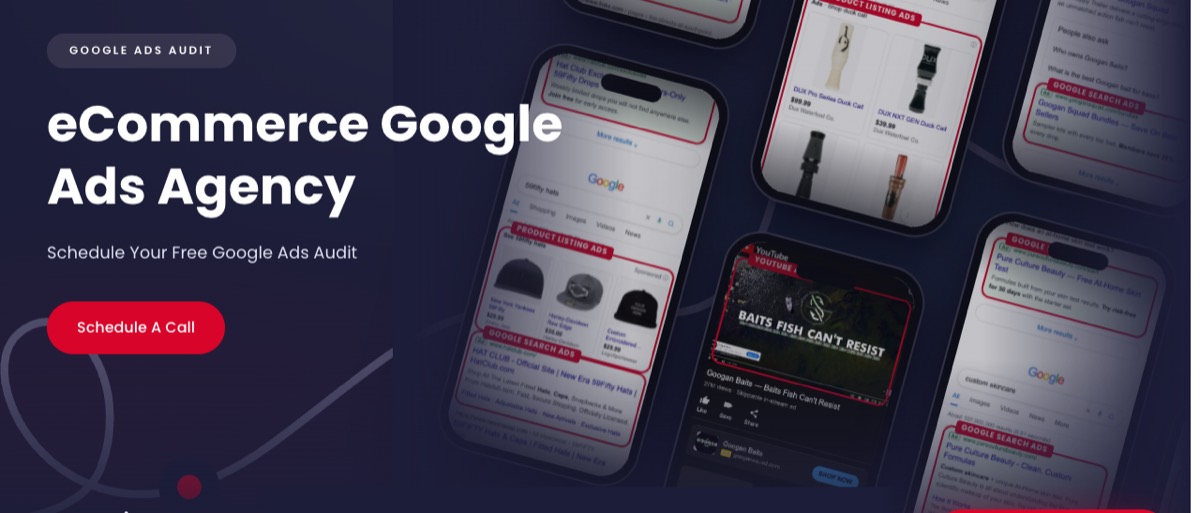
Overview. We're a boutique performance marketing agency for DTC eCommerce brands on Google and Meta — owner-led, with a small senior team. 15+ years, $200M+ in lifetime managed ad spend, accounts from $20K to $1M+ a month. A senior operator runs your Google account day to day and makes the calls on your spend, so you get experienced judgment instead of a junior learning on your budget.
Why we stay small on purpose. We take on a limited number of brands at a time and turn down the ones we don't believe we can move the needle for, because senior attention doesn't scale to hundreds of accounts and we won't pretend it does. The founder comes from a computer science background and builds our proprietary tooling, M-K-O-S (mkos.ai), while running client accounts — so the person shaping your Google strategy is the one who built the system executing it. Human strategy, AI execution.
The proof, current and specific. On Google, we took an underperforming account from $82.5K to $331K in monthly spend while improving ROAS on the way up. On another, 3.48x ROAS on $87K in spend — $303K in revenue, 35% above the prior-year benchmark. Our best single result across channels: an extra +$100K/month at 3x ROAS, run entirely on AI-generated ads, after creative production had capped the brand's scale. On Meta we've held ~4x ROAS at $250K+/month. For fashion and jewelry brands, 2.5x–4x at scale.
How we fit the seven criteria. We optimize to incremental, new-customer lift, not platform-inflated ROAS. We separate brand from non-brand and bid to target ROAS, run PMAX for prospecting and Shopping for mid-funnel, and don't let PMAX quietly harvest your branded search. Every engagement includes unlimited performance creative, powered by M-K-O-S and scoped to your budget — so creative volume is never the ceiling it is at production-bound shops. We only do eCommerce, no lead-gen split. Want the full picture? Pair Google with our Meta ads agency for DTC brands, or see our broader performance-marketing roundup.
Notable clients. Googan Squad, MaxiClimber, Gorjana Jewelry, HatClub, Finks Jewelers, R. Riveter, Crib of Art, and Alani Nu prior to its acquisition.
Best fit for. DTC eCommerce brands doing $2M+ a year that want a senior operator and unlimited performance creative — not the cheapest seat.
The honest caveat. This isn't the cheap option. Our retainer starts at $6K+/month and we require $20K+/month in ad spend, priced on the tooling and senior time, not hours. If you're below that spend floor or you want the lowest invoice, we're the wrong call — and one of the picks below will serve you better.
Ready to talk? Schedule a call.
See where your account is leaking budget. Book a free Google Ads audit and we'll walk your brand-versus-non-brand split and PMAX structure with you.
2. Directive Consulting — Best for B2B & SaaS Pipeline
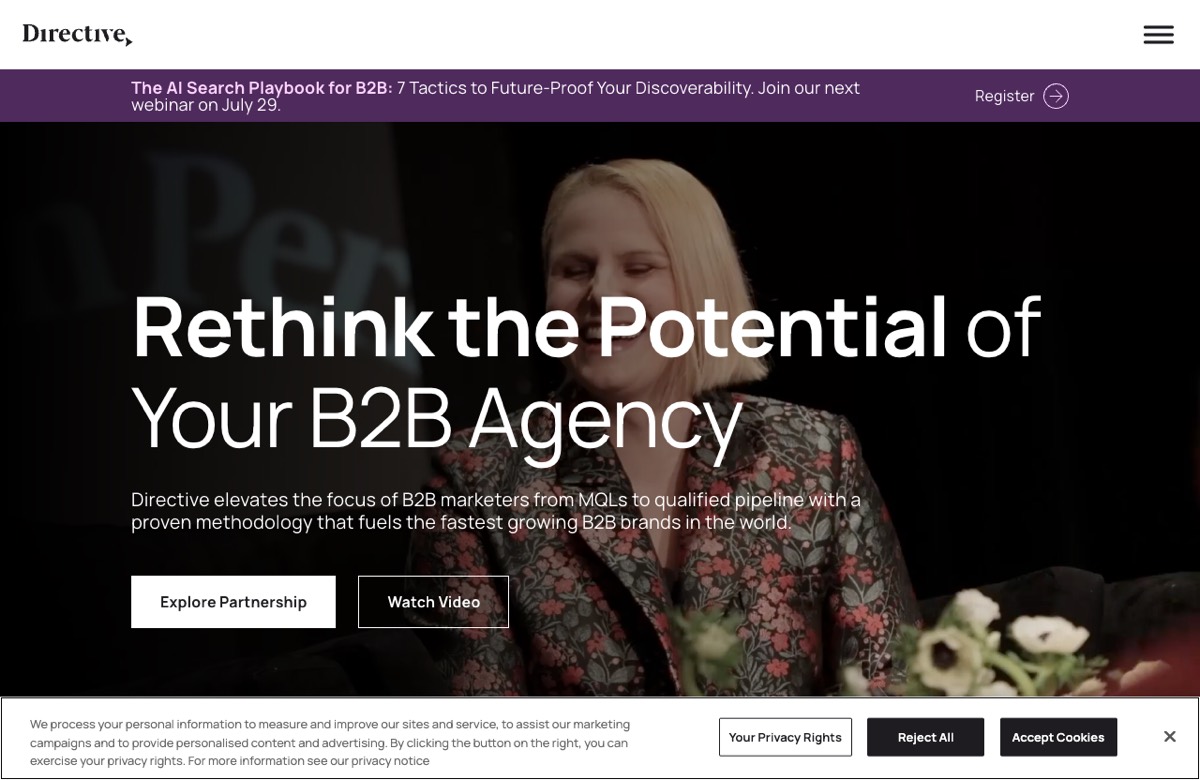
Directive built its reputation on B2B and SaaS. Their "Customer Generation" methodology, their case studies, and their reporting are written for pipeline, SQLs, and long sales cycles — not carts, AOV, and first-order profitability. For a software company that lives on demo bookings, that focus is a real strength.
Honest fit note. If you're a DTC eCommerce brand, this is a lane mismatch, not a knock on the work. A B2B lead-gen playbook optimizes for different metrics than profitable eCommerce scaling. Great for SaaS, wrong sport for a product brand.
3. Silverback Strategies — Best for Enterprise Performance
Silverback Strategies is a performance agency running paid search and paid social for mid-market and enterprise brands, and they publish their own analysis of the best Google Ads agencies, so they clearly live in the category. For a larger brand with layered stakeholders that wants a seasoned team across search, that's a solid fit.
Honest fit note. Their center of gravity is bigger, multi-vertical accounts. A lean DTC brand that just wants one senior operator on Google and Meta economics may find an enterprise-shaped shop heavier than it needs.
4. Searchbloom — Best for SEO + Google Ads Together
Searchbloom pitches search holistically — organic and paid working as one system, with paid search sitting alongside a strong SEO practice. If your growth plan leans on ranking and Google Ads together and you'd rather have both under one roof, that integration is the draw.
Honest fit note. SEO is half of what they do, so paid-search depth is split with organic. A DTC brand scaling hard on Shopping and PMAX — where feed economics and creative volume decide the outcome — may want a team that lives only in paid.
5. LYFE Marketing — Best for Small Budgets & SMBs
LYFE Marketing serves small businesses with social media management and PPC at accessible price points. For an SMB spending a few thousand a month that wants managed paid search without an enterprise retainer, that's a genuine fit and a fair entry point.
Honest fit note. The model is built for small budgets and breadth, not scaling a DTC account into six figures a month on target-ROAS bidding. If your constraint is scale rather than price, this isn't the tier you're shopping.
6. The Frank Agency — Best for Mid-Market Retail
The Frank Agency is a full-service advertising shop working with mid-market and retail brands across media, creative, and strategy. For a brand that wants a traditional agency covering brand and media together under one contract, that breadth is the appeal.
Honest fit note. Full-service generalists spread across brand, media, and creative. A DTC brand that needs a specialist scaling Google Ads on unit economics may want depth over breadth.
7. Scalix AI — Best for AI-First Campaign Management
Scalix AI positions around AI-driven campaign management and publishes its own Google Ads agency ranking, so paid search is clearly core to what they do. If an AI-first workflow is specifically what you're shopping for, that's their pitch.
Honest fit note. "AI-first" describes the tooling, not the vertical. Confirm how much of their book is DTC eCommerce versus lead-gen or B2B before you assume your account lands with people who speak CAC and AOV.
8. KlientBoost — Best for CRO-Driven PPC
KlientBoost pairs paid search and paid social with conversion-rate optimization and landing-page design, so the media and the page it points to get built together. For a brand whose funnel leaks at the landing page as much as in the auction, that combination is a real strength.
Honest fit note. Their book spans eCommerce, lead-gen, and B2B, so DTC is one lane among several. Confirm the pod on your account lives in eCommerce economics, not lead-gen.
The One Thing That Decides Which Google Ads Agency Scales You
Most of the agencies above are genuinely good at what they do. If you're a B2B software company, an SMB on a small budget, or a retailer wanting a full-service shop, one of them is a better call than we are — and we've said so where it's true.
But if you're a DTC eCommerce brand trying to scale profitably on Google, one dimension quietly decides how far you get: whether the agency optimizes to real incremental profit or to the flattering platform number. Every shop can turn PMAX on. Almost none will separate the credit crabs from the customers you actually won, cap PMAX from eating your branded search, and keep enough distinct creative in market that Google never runs out of assets to test. That's the exact gap we built M-K-O-S to close — cross-channel measurement that reads incrementality, and unlimited performance creative scoped to your budget, run by a senior operator instead of a junior. A small book per operator, senior attention on every account, and a measurement view most agencies still won't show you. That's the line between an agency that manages your Google account and one that actually scales it.
Before You Sign: What the Best PPC Agencies Charge + Red Flags
Pricing across the best PPC agencies usually takes one of three shapes. Name them honestly and you'll read any proposal faster:
| Pricing model | How it works | The catch to watch |
|---|---|---|
| % of ad spend | The fee scales with how much you spend | The incentive is to grow spend, which isn't always the same as growing your profit |
| Flat retainer | A predictable monthly fee regardless of spend | Simple and aligned — ours is $6K+/month, priced on tooling and senior time, not hours |
| Hybrid | A base retainer plus a performance component tied to a real outcome | Fair when the outcome is defined honestly; vague if the "performance" metric is platform ROAS |
One: the math has to work for you. Walk the money down the page. Ad-driven revenue, minus COGS and ad spend, leaves your contribution margin. The agency fee comes out of that contribution margin before your operating expenses. So the fee only makes sense when the incremental profit the agency drives is a large multiple of the fee. At 3–4x ROAS on $20K–$25K+/month with healthy DTC margins, a $6K retainer is a rounding error against the lift. Below that floor, the fee eats too much of the contribution to be rational — for you, not for us.
Two: the algorithm needs conversion volume. Google's automated bidding — target ROAS, PMAX — needs enough conversions to learn. Thin spend means thin data, which means the machine can't optimize and your budget gets wasted while it guesses. The floor is the point below which Google Ads simply can't be run properly.
There's a capacity tell hiding inside the price, too. A senior operator runs two to four accounts, five at a stretch, so each one gets real attention. The shops that underprice usually do it by loading ten to fifteen accounts onto one manager. That's not an expertise gap, it's a split-attention gap — and it's why they're cheaper and why your account lands with a junior. Even with AI tooling doing the production heavy lifting, human strategic attention per account is the constraint. Ask any best PPC management company how many accounts one person carries, and do the math yourself.
Red flags to watch for. None of these name an agency. They name a type — the corners a bad provider cuts, whoever it is:
| Red flag | What it usually means |
|---|---|
| Reports only in-platform ROAS, never incremental or new-customer | The account is claiming credit crabs — repeat buyers, brand search, view-through — that would have converted anyway |
| Won't tell you how many accounts one manager carries (or it's ten-plus) | Split attention. A junior runs your spend while the senior who pitched you moves on |
| Caps creative concepts, or can't give a clear monthly number | Production is their bottleneck, and it becomes your growth ceiling on Google's asset-hungry campaigns |
| Lets PMAX absorb branded search and reports it as performance | You're paying to reconvert people already searching for you, dressed up as new growth |
| Long lock-in contract with opaque fees | The results won't hold you, so the contract has to |
| "Guaranteed #1" or "results in 30 days" | Real incrementality and PMAX learning take longer; fast promises usually mean platform-inflated numbers |
Want a scaling plan built from your real numbers? Book a call and we'll pressure-test your account against all seven criteria.
Best Google Ads Agencies: Frequently Asked Questions
Is $20 a day good for Google Ads?
For a local service business testing one keyword theme, $20 a day (about $600/month) can work. For a DTC eCommerce brand, it's below the floor where Google's automated bidding gets enough conversion data to optimize — thin spend means thin data means the algorithm can't learn. That's the same reason serious Google Ads agencies set a $20K+/month minimum ad spend: below it, target-ROAS and PMAX can't be run properly.
What are the top 5 ad agencies?
There's no universal top 5, because the right agency depends on your model. For DTC eCommerce Google Ads specifically, the top of our shortlist is Paul Klebanov (scaling profitably on Meta + Google), Directive Consulting (B2B and SaaS pipeline), Silverback Strategies (enterprise performance), Searchbloom (SEO and Google Ads together), and KlientBoost (CRO-driven PPC) — with three more picks above spanning SMB, retail, and AI-first shops. Score any of them against the seven criteria in this guide rather than trusting a ranking alone.
How much do agencies charge to run Google Ads?
Typically one of three ways: a percentage of ad spend, a flat monthly retainer, or a hybrid tied to results. Serious DTC shops commonly run retainers from roughly $3K to $10K+/month with a minimum ad spend attached. Ours is $6K+/month with a $20K+/month spend minimum, priced on proprietary tooling and senior time rather than hours. Search the best adwords agency — the legacy name for Google Ads — and you'll see the same three pricing shapes; what matters is judging the fee against the return it produces, not the invoice in isolation.
What are the big 4 ad agencies?
That phrase points to the global holding companies — traditionally WPP, Omnicom, Publicis, and Interpublic (IPG), though the holdco field is consolidating as Omnicom and IPG combine. They run brand and media for the world's largest advertisers. For DTC performance on Google, though, you don't want a holdco — you want an operator who personally runs the account, reads incrementality, and keeps enough creative in market to scale. That's a different job than a holding company is built to do.
Score any agency against the seven criteria and you'll spot the corner-cutting before it costs you a quarter. If you're a $2M+ DTC brand that wants a senior operator running Google as one profitable system, schedule a call.